What a Slow Week in a Japanese Camper Actually Feels Like
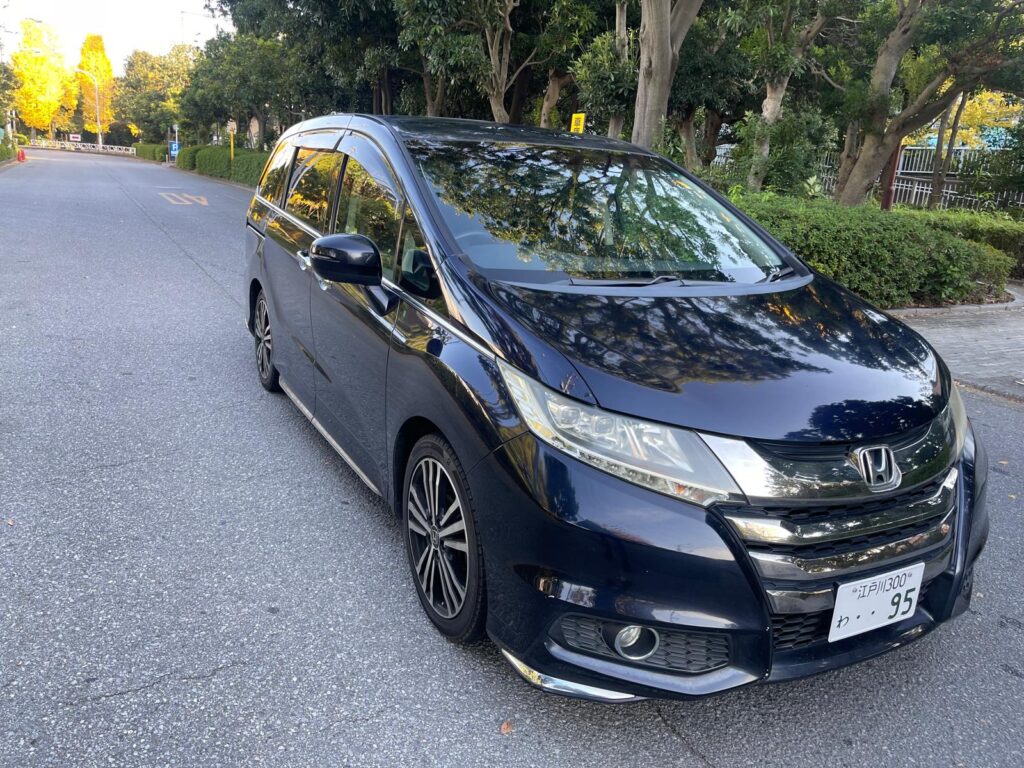
We get asked, often, what to “do” in a camper for a week in Japan. The honest answer is that the doing falls away after about day two. The driving becomes its own thing, and the question quietly shifts from where to where, to what kind of day this is going to be.
This is a record of a week we drove last autumn, in the Honda Odyssey, with no agenda except to be there. It’s not a recommendation. It’s a shape.
Day one — leaving Tokyo at the wrong time of day
We left at three in the afternoon, which is exactly when you shouldn’t. The Chuo expressway slows to a thirty-kilometre crawl through the Otsuki section in the late afternoon, and the camper feels too big for stop-and-go. We knew this. We left anyway.
Somewhere past Sasago the tunnels swallowed us, and when we came out the light was already low and gold over the Kofu basin. By six we were off the expressway, on a single-lane road through grape orchards, and the camper finally felt like the right shape for the trip. Kawaguchiko at seven-thirty. We didn’t go to the lake. We parked at the michi-no-eki, made instant ramen on the little stove the van comes with, and went to bed.
The bed in the Odyssey is not a camping bed. It is a bed. You sleep flat.
Day two — the lake at five-twenty in the morning
The thing about sleeping by a lake is that you wake up at the lake. No commute, no checkout. The window beside the bed faces east. At five-twenty the light started, and we got up because there wasn’t anything else to do.
The mist sits on Kawaguchiko in a particular way at that hour. It curls off the water in slow ropes that don’t go anywhere — they just hang. Mt. Fuji isn’t visible yet at five-twenty, but you can tell where it is by the gap in the cloud where the sky is empty. By six the gap fills with mountain, and you have about twenty minutes of the postcard before the tour buses start arriving in Kawaguchiko town.
We didn’t take the photo. We made coffee. The Odyssey has a small kettle and a fold-out table that fits two mugs and a notebook.
Breakfast at Idle Moment, a tiny cafe on the north shore that opens at seven. The owner has a black cat that sleeps on the cash register. He does pour-over coffee one cup at a time and the toast comes with a wedge of butter from a dairy in Hokuto.
Day three — the drive that turned into a stop
We were going to drive west, towards the Minobu line and the Nirasaki cliffs. We made it about forty kilometres before we passed a sign for a michi-no-eki we hadn’t heard of, “Tomizawa”, set back from the road in a forest of cedar. We pulled in for the toilet break and the woman at the local-produce counter handed us a sample of plum pickle made by her sister-in-law. We bought a jar. We bought a bag of fresh wasabi leaves. We bought a half-kilo of mountain miso. We ended up parked there for four hours, sitting outside the van at a picnic table the michi-no-eki keeps for visitors, eating bread and pickled plums.
The drive to Nirasaki was forty minutes the next morning. It would have been the same drive forty minutes from the lake. The forty minutes of stillness in between belonged to that wooden picnic table.
Day four — fog over the highway
It rained in the night. We woke to thick fog and a temperature drop, and the highway south of Kofu was a moving wall of grey. The camper does not like fog at speed, so we slowed to sixty. The drivers behind us also slowed to sixty. No one honked. Japan has a particular grace about this — the slower car sets the pace and that is the pace.
By the time the fog lifted we had crossed into the south of Yamanashi and the road was the only one in a valley between hills that were just turning their leaves. We stopped at a place called Yumura Onsen, a tiny hot-spring town that almost no foreign travellers know about. The local bathhouse is ¥450 and the dressing room has a wooden floor that creaks in exactly two places.
The water there is unscented and just-warm-enough, not the harsh sulphur of the bigger onsen towns. We stayed an hour and a half and came out feeling like the week had only just started.
Day five — the family running the michi-no-eki
There is a michi-no-eki in the south of Yamanashi called Minamikoshu. It is not on any tourist map. We stopped because we needed water.
The family that runs it — grandmother, mother, son, four-year-old granddaughter — were sitting outside drinking tea when we arrived. The grandmother got up, refilled our water bottles, refused payment, and handed us a small bag of persimmons from a tree behind the building. The four-year-old wanted to see the van. We let her climb in and sit on the bed. She asked her mother, very seriously, whether she could also have a house like that. Her mother said maybe when she was older. The girl considered this, and accepted it with the gravity of a small judge.
These are the moments that make the camper. Not the photos, not the kilometres. The four-year-old in the bed, deciding it was a sensible idea.
Day six — back towards Tokyo, the long way
We could have been back in Tokyo by lunchtime. Instead we took a long mountain road over the Saitama border, north through Chichibu, and stayed our last night at a tiny RV park run by a retired carpenter and his wife. The site has six pitches and a small bathhouse the carpenter built himself out of cedar planks. He charged us ¥3,500. He insisted we take a beer from the fridge before bed. We accepted. We sat outside the van until the stars came out over the ridge, which they did, in great quiet quantities.
Day seven — Tokyo, slowly
The drive back into Tokyo took five hours because we kept finding reasons to stop. A roadside soba place in Hanno. A flea market in Saitama. A railway crossing where we sat in the camper and watched three trains go past because there is nothing more satisfying, somehow, than watching trains.
We returned the van at three in the afternoon. The whole trip — six nights — had cost less than a long weekend at a Hakone ryokan, and contained more weather, more strangers, and more shapes of light than we knew how to remember.
What you’ll find, if you do this
You’ll find that a camper is not a vehicle for going places. It is a vehicle for stopping in them. The driving is incidental — the parking is the thing. The week is shaped by where you let yourself stop, and how long you let the stops last.
You’ll also find that Japan, away from the cities, runs on a slower clock than anywhere we’ve travelled. Cafes that open when the owner is awake. Onsens where the staff bow to you as you leave. Roadside stalls that take cash on trust and leave the change in a wooden bowl.
We built this small fleet — the Mazda Premacy, the Honda Stepwagon (Black), and the Odyssey we drove that week — for journeys like this. They aren’t fast. They aren’t loaded with features. They have a bed, a stove, a kettle, and a window that opens onto wherever you stopped for the night.
If that sounds like the trip you’re trying to take, send us a note. We’ll talk about dates.