The Shikoku 88-Temple Loop, Without the Bus
The Shikoku 88 temple pilgrimage — the henro — is the oldest organised walk in Japan still done at its original pace. It was set out in the 9th century by the monk Kūkai, takes around forty days on foot, and circles the island of Shikoku in a clockwise spiral, temple to temple, sea to mountain to forest to sea.
Most modern pilgrims do it by tour bus, in eight days, with a guide. We don’t recommend that version. The temples are the same, but the rhythm is wrong. The whole point of the loop is the walking — and if you can’t walk it, the closest thing is the camper.
This is the slow-camper version of the henro. Sixteen days, eighty-eight temples, no rush, and the freedom to spend two hours at the small ones and twenty minutes at the famous ones.
What the henro is, briefly
It is a circuit of 88 Buddhist temples around Shikoku — the smallest of Japan’s four main islands. The temples are numbered 1 to 88 in a clockwise sequence starting near Naruto in Tokushima prefecture. Each temple sells a small stamp (nōkyō) to mark your visit; the act of collecting all 88 is the formal completion of the pilgrimage.
Walking it takes 40–60 days. By bicycle, 20. By car, the route can be driven in 7–10 days at tourist speed, but it isn’t really a pilgrimage at that pace. Sixteen days in a camper is the middle ground — slow enough to find the small temples, fast enough that you’ll see your week through to the end.
The shape of the route
Shikoku is divided into four prefectures, and the henro takes each one in turn:
- Tokushima — temples 1 to 23. The starting prefecture, with the closest temples bunched in the north-east. Easy days.
- Kōchi — temples 24 to 39. The longest leg. Wide coastal stretches, Pacific cliffs, sparse temples. The “discipline” prefecture.
- Ehime — temples 40 to 65. Mountain temples on the west side. The most beautiful, in our opinion.
- Kagawa — temples 66 to 88. The closing stretch. Smaller distances between stops, gentler land, the sense of nearing an end.
In a camper, the rhythm is roughly: three or four temples in the morning, a long lunch and a walk somewhere that isn’t a temple, two or three temples in the afternoon, find a michi-no-eki or a small campsite for the night.
Tokushima — the easy beginning
You will start at Temple 1, Ryōzenji, a small wooden temple set back from the road in Naruto. We always tell first-time pilgrims to spend a full hour here even though they have nowhere to be. There’s a small bookshop selling the henro guidebook and the white pilgrim vest. The shopkeeper, if you let her, will explain how to ring the bell — three times, never four. Four is the number for funerals.
Temples 1 to 11 are within ten kilometres of each other. You can do them in an afternoon. We always slow this down.
The first night, we like to park at a small RV-friendly stop called Sansan-no-Sato near Tokushima city — a quiet farm with cedar trees and an open hot bath that’s free for camper guests if you ask the owner. He’ll come out, point at the bath, point at the van, and wave you in.
By temple 12 — Shōzanji, the first proper mountain temple — the henro changes. The road climbs eight kilometres of switchbacks through cedar forest. You park at the foot. You walk forty minutes up. You arrive at a wooden gate, a stone basin, a moss-covered courtyard, and a view down the valley that looks like it hasn’t changed since 1200. The walk up is the temple, not the building.
Kōchi — the long coast
The Pacific side of Shikoku is the prefecture pilgrims dread, because the temples are far apart and the days are long. In a camper this becomes its strength.
The drive from temple 23 to temple 24 is 75 kilometres of coastal road through cliffs and lighthouses and small fishing harbours where the day’s catch is being sorted on the dock. You can do it in an afternoon. Or you can stop, four times, and watch a fisherman mend his net, and buy a piece of grilled fish from a roadside stall, and end up at temple 24 — Hotsumisakiji, on the very tip of Cape Muroto — at dusk, when the temple bell is being rung by a single monk for the evening service.
We always sleep that night at the Cape Muroto Skyline parking — free, perched on a headland, with the Pacific on three sides and the lighthouse turning slowly above you. The wind moves the camper at night. It is not a quiet sleep. It is a deep one.
Further along the Kōchi coast, Temple 27 — Kōnomineji — sits at the top of a small mountain reached by a 4 km single-lane road that no tour bus can take. The walk from the parking lot is twenty minutes through bamboo. The temple itself is open to the sky on the south side, looking straight down onto the ocean a thousand metres below. We have never been there with another visitor.
Ehime — the mountain temples
Crossing into Ehime, the henro turns inland. The temples here are higher, the days quieter, and several of them — 44, 45, 60, 65 — are reached only by foot from a parking area twenty or thirty minutes away.
Temple 45 — Iwayaji is the one we always tell people about. It is built into a cliff face. The main hall sits halfway up a vertical rock wall, reached by a stone staircase pinned into the rock. You climb to the hall, and then if you want to go further, there is a chain ladder bolted to the rock that leads to a small praying-cave above the temple. Almost nobody goes up the ladder.
The campervan rhythm here works because you can park, walk, sit in the temple, walk back, drive twenty minutes, sleep at a small michi-no-eki, and start the next day at six in the morning at temple 46. The pace is what the route asks for.
Kagawa — the closing stretch
The last twenty-three temples are closer together and the land softens. There are good cafes in Takamatsu. There is Yashima temple with its view of the Inland Sea. There is the small temple Kokubunji (no. 80) with a 1,300-year-old wooden five-storey pagoda. There are days that feel less like pilgrimage and more like a long, warm conclusion to something.
The final temple — Ōkuboji, number 88 — is at the end of a small mountain road, in a clearing of cedar trees. The custom is to ring the bell, leave the white vest at the temple, and walk back to your car in silence. We have done this twice. Both times we sat in the camper afterwards for an hour before we drove. There was nothing else to do, and the not doing was the point.
What it takes
- 16 days in the camper. Round trip from Tokyo with the Setouchi expressway, about 18 days total.
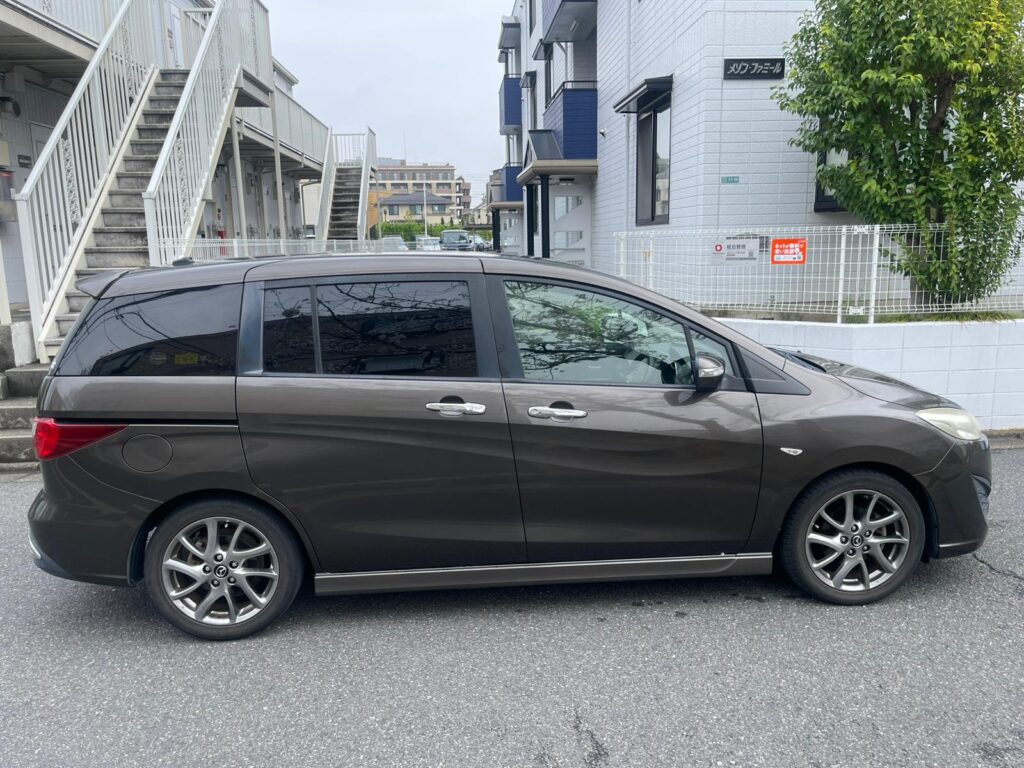
- A van that handles narrow mountain roads. The Mazda Premacy is what we recommend — low, narrow, easy on the switchbacks. The Honda Shuttle also works well on the henro.
- Two pairs of comfortable walking shoes. Several of the temples require a twenty to forty minute hike from the parking lot.
- A willingness to put away the schedule. The henro is not a checklist. It rearranges your sense of time.
We have a longer document we send to people who book this route — temples worth lingering at, the small RV-friendly stops we trust, the cafes, the order to walk Iwayaji’s chain ladder. If this is the trip you’ve been considering, tell us. The fleet was built for journeys like this one.